
Intelligent Control Solutions for Electrode Boilers

High-Efficiency Electrode Boiler Control
Electrode boilers use electricity to produce heat directly in water by running current through submerged electrodes. The water heats up and produces steam or hot water due to its electrical resistance. Since combustion is unnecessary, this approach offers a safe and effective way to heat industrial spaces.
An industrial-grade electrode boiler system for process heating is designed, supplied, and operated. The aim is to deliver a high-efficiency, sustainable steam production system that facilitates operational flexibility, quick reaction times, and lower emissions. Advanced automation and safety controls will be integrated into the system to ensure reliable operation under various load scenarios.
Key Points
-
- High Efficiency: Thermal efficiency exceeds 99.9%, ensuring minimal heat loss.
- Rapid Response Time: Steam is available immediately with quick start-up and shut-down.
- Minimal Maintenance: The absence of burners or fuel systems results in reduced operational costs.
Requirements Analysis
Initial Assessment:
In many industrial process heating applications, steam is required on demand and must be produced efficiently, reliably, and without harmful emissions. Traditional steam generation methods involve combustion-based boilers, which present challenges such as high maintenance costs, delayed startup times, fuel storage requirements, and environmental impact due to the emission of CO₂ and other harmful gases.
The electrode boiler offers a clean alternative by using the conductive properties of water to generate steam directly through an electrical current. Since the water itself acts as the heating element, the process is highly efficient, with no need for combustion.
To ensure consistent and safe operation, especially under varying load conditions, a precise and responsive control system is required. This system must monitor water temperature, electrode current, and steam pressure in real-time.
Key Requirements:
- Control System Integration
- Compatibility with existing SCADA/PLC systems.
- Remote monitoring and data logging capability.
- Interface for manual override and diagnostics.
- Safety Features
- Overtemperature and overpressure protection.
- Redundant cutoffs and alarms.
- Compliance with industrial safety standards
- Energy and Sustainability
- 99% thermal efficiency.
- Zero emissions, no CO₂, other harmful gases, or particulate output.
- Operable on renewable electricity sources.
Solution Design
Libratherm Product Selection
- Thyristor Power Switch
(POW-3-ZC)
These thyristor power regulators control the boiler’s temperature by supplying current to the electrodes. When the temperature drops below the set point, the regulators activate and deliver a steady current to the submerged electrodes, generating heat. The zero-crossing firing prevents the generation of high-voltage spikes and surges. The switches also feature an auto-cutoff function for firing in the event of overtemperature. It has suitable RC snubbers and surge suppressors to protect the SCR Modules.
- Temperature and Current Controller
(TAC-966)
The TAC-966 monitors the boiler temperature and the current passing through the electrodes. Based on the feedback, it receives input from temperature sensors and transmitters, and regulates the thyristor power units to maintain the desired heating level.
- Temperature and Pressure Switch
(TPS-966)
The TPS-966 functions as an on-off controller, monitoring the steam pressure within the boiler. Once the set pressure is reached, the system is turned off and reactivated to maintain consistent pressure.
- Pressure Transmitter
The pressure transmitter monitors the pressure building up in the boiler. It can be configured to a required set point. When the boiler pressure reaches the set point, the transmitter sends a signal to the temperature and pressure switch.
System Architecture
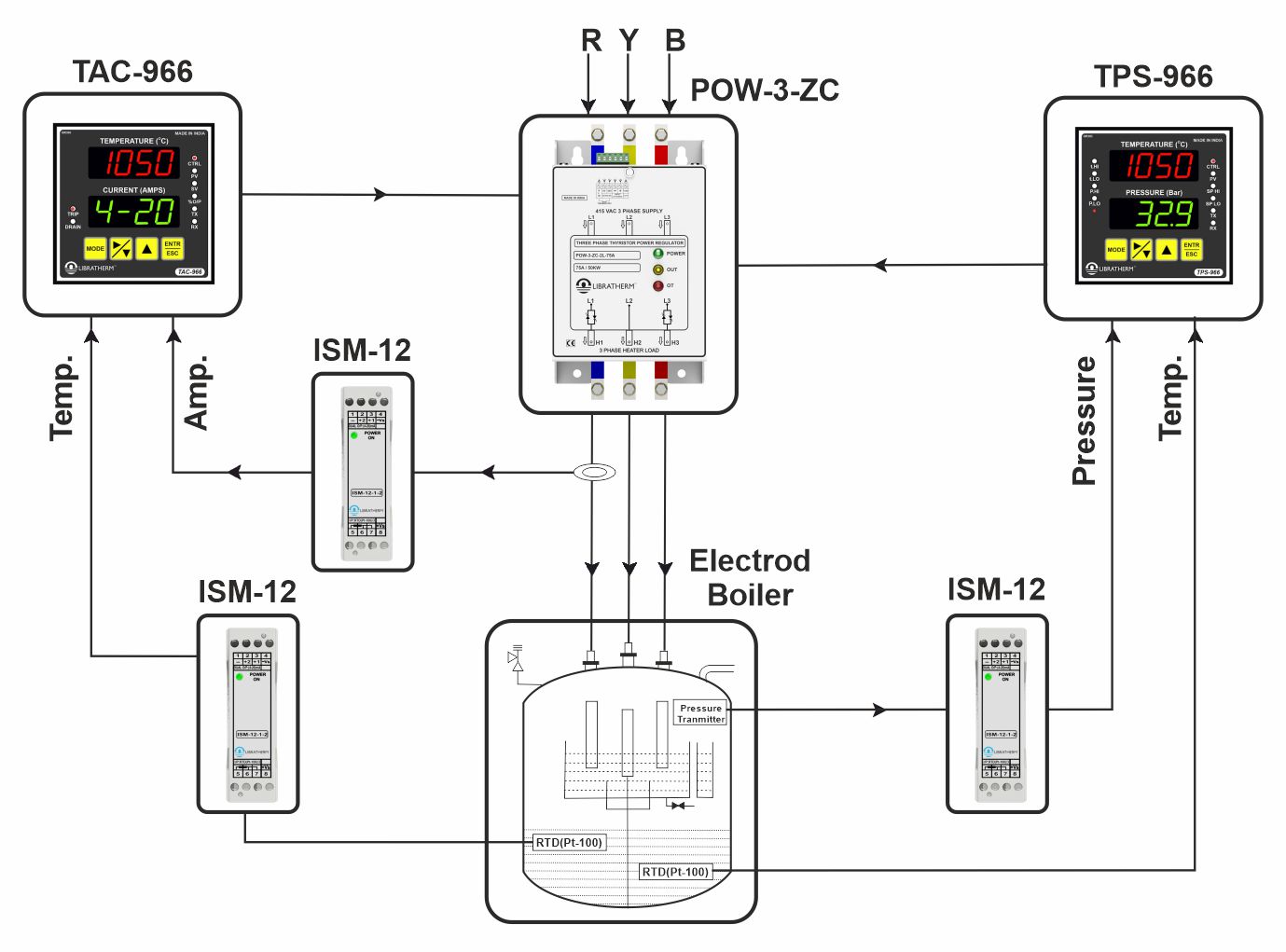
Closed Loop System
The operation of an electrode boiler begins with treated water being fed into the boiler's pressure vessel. Water level sensors ensure that the electrodes remain partially submerged. The water must have a specific conductivity to allow the electric current to pass through it.
Thyristor power switches supply energy to the electrodes after the boiler is turned on. Depending on the need for heating, these regulators regulate the current flow. The water's inherent electrical resistance produces heat as the current passes through it, rapidly increasing the temperature until steam is created. After rising to the top of the vessel, the produced steam is sent to the designated process through a steam outlet.
A temperature and current controller continuously monitors the electrode current and boiler temperature during this operation, adjusting the power levels as needed. By turning the power on and off when the predetermined pressure is reached, the temperature and pressure switch simultaneously ensure that the steam pressure stays within safe bounds.
Benefits
-
Zero Emissions and Environmentally Friendly
Electrode boilers operate without combustion, producing no CO₂ or other harmful gases. This makes them ideal for facilities committed to sustainability and carbon neutrality.
-
High Efficiency with Rapid Steam Generation
With an efficiency of over 99.9%, electrode boilers heat water directly through water conductivity, enabling almost instantaneous steam production with minimal energy loss.
-
Low Maintenance and Operational Costs
These systems do not feature burners, fuel pumps, or chimneys, resulting in fewer moving parts. This leads to lower maintenance requirements and a longer service life.
-
Compact Design and Easy Installation
Electrode boilers require minimal floor space and do not need fuel storage or exhaust systems, making them easy to install in new and retrofit projects.
-
Safe and Reliable Operation
There is no risk of fuel-related fire or explosion. With rapid shutdown capabilities and built-in electrical and thermal protections, electrode boilers ensure a safe operating environment.
Key Takeaways
Designing and deploying the Electrode Boiler Control System showcases a forward-looking approach to clean, efficient, and automated industrial steam generation. With seamless integration of Libratherm’s advanced control products, including thyristor power regulators, temperature and current controllers, and safety switches. The system delivers unmatched energy efficiency, precision, and safety. It reflects a significant step toward sustainable process heating solutions in industries aiming to reduce emissions and operational complexity.
- Summary
The Electrode Boiler Control System's primary objective was to ensure dependable, closed-loop steam generation through effective power regulation, precise temperature and pressure control, and robust safety features. The TAC-966 temperature and current controller, the TPS-966 pressure switch, the Libratherm thyristor power switches (POW-3-ZC), and a differential pressure transmitter are all used in the solution to provide precise process control. Direct water heating using submerged electrodes is the best option for contemporary, eco-friendly industrial applications, as it ensures rapid steam production, minimal maintenance, and emission-free operation.
- Future Prospects
There is encouraging potential for the Electrode Boiler System to be widely adopted by enterprises looking to switch to clean and energy-efficient steam generation. Due to its modular and scalable design, the system can be readily integrated into larger centralised heating networks or upgraded to handle higher capacities. It is ideal for enterprises adopting green energy initiatives due to its interoperability with renewable energy sources. This system is a flexible and future-ready solution for sustainable industrial heating applications, as its basic technologies and control architecture can be modified for various thermal processes, including humidification, sterilisation, drying, and pasteurisation.
The control panel implemented by Libratherm for Electrode Boilers offers a proven, customizable, and efficient option for businesses in various industries. Please contact Libratherm for more information or a consultation. Our team of experts is ready to assist in designing and implementing a control panel tailored to your specific needs, ensuring optimal performance and quality in your operations.