Choosing the Right Transmitter for Your Process Control System
Introduction
Transmitters play a vital role in industrial process control by ensuring accurate measurements, stable signals, and system reliability. They convert sensor signals into standard outputs, such as 4 to 20 mA, 0 to 10 V, or RS-485, enabling seamless integration with control systems, including PLCs, DCS, and PID controllers.
Transmitters are used across industries for applications including temperature and pressure monitoring in furnaces and hydraulic systems, as well as humidity, flow, and level control in HVAC and water treatment plants.
Selecting an inappropriate transmitter may result in inaccurate data, signal disturbance, process interruptions, or increased operational expense. Accurate transmitter selection is critical for maintaining efficiency, dependability, and system longevity.
How Transmitters Work
Transmitters serve as signal translators. A sensor detects a physical parameter, such as temperature, pressure, or flow, and produces a small electrical signal. The transmitter then processes this signal through several key functions:
- Amplification increases the signal strength so it can be transmitted reliably.
- Isolation keeps the input and output electrically separate, which helps prevent ground loops.
- Linearisation changes non-linear sensor responses into directly proportional outputs.
- Conversion turns the conditioned signal into standard industrial formats, such as 4 to 20 mA or 0 to 10 V.
The standardised signal is sent to the PLC or DCS, which uses it to control actuators, alarms, or display systems.
Electrical isolation, noise immunity, and precise calibration are essential for maintaining signal integrity in industrial environments.
What is a Loop-Powered Transmitter
A loop-powered transmitter is a compact, energy-efficient device that operates entirely on the power supplied through the 4-20mA current loop. This eliminates the need for a separate power source. In this configuration, the same two wires provide both operating power and the output signal, significantly simplifying wiring, reducing installation costs, and improving system reliability.
The transmitter draws a small amount of energy from the loop, conditions the sensor input, and modulates the current between 4 mA and 20 mA based on the measured parameter. This makes loop-powered transmitters highly suitable for long-distance signal transmission, remote field installations, and electrically noisy industrial environments.
All Libratherm transmitters are built using this loop-powered architecture to ensure robust communication, minimal wiring complexity, lower power consumption, and seamless integration with PLC, DCS, SCADA, and PID control systems.

Types of Transmitters
Transmitters are classified by the process parameter they measure. Matching transmitter types with sensors and environments helps engineers select the best fit. They are also differentiated by whether their input, output, and power circuits are electrically separated. This classification helps users choose the right transmitter based on noise levels, installation distance, and safety requirements.
Non-Isolated Transmitters
Function
Non-isolated transmitters share a common electrical ground among their input, output, and power circuits. They are designed for straightforward, low-noise installations in environments with minimal electrical interference.
How They Work
Since the circuits are directly connected, the transmitter conditions and scales the sensor signal without any isolation barriers. This design makes the device compact, energy-efficient, and cost-effective, particularly for applications that do not require electrical separation. This makes the device compact, energy-efficient, and more cost-effective for applications that do not require electrical separation.
Isolated Transmitters
Function
Isolated transmitters provide galvanic isolation between the input, output, and power source. This electrical separation shields the system from noise, surges, and ground-loop problems that are typical in industrial settings.
How They Work
Isolation is achieved using components such as optocouplers, transformers, or isolation amplifiers. Signals can be sent to these components without a direct electrical connection. This guarantees correct signal transmission over long distances or in noisy industrial environments by preventing undesired voltage from one circuit from impacting another. This prevents unwanted voltage from one circuit from affecting another and ensures precise signal transmission over long distances or in noisy plant areas.
Types by Measured Parameter
1. Temperature Transmitters
Function:
Temperature transmitters accept input from sensors like RTDs or thermocouples and convert these signals to standard outputs, including 4 to 20 mA, 0 to 10 VDC, or RS-485 (Modbus RTU).
How They Work:
A temperature sensor measures the process temperature and sends a signal to the transmitter. The transmitter conditions and amplifies the signal. It corrects for sensor errors and ensures electrical safety before sending the output to a PLC, DCS, or PID controller.
2. Pressure Transmitters
Function:
Pressure transmitters receive input from a pressure sensor or strain gauge and convert it into a corresponding analogue output. This enables monitoring and control of pressure in hydraulic or pneumatic systems.
How They Work:
When pressure is applied to the sensing diaphragm (the sensor's sensitive part), it alters the electrical resistance or capacitance (the ability to store electrical charge). The transmitter converts this change into a linear electrical signal, isolates it, and scales it for process controllers.
3. Level Transmitters
Function:
Level transmitters measure the height or level of liquids or solids in a tank, reservoir, or silo and convert it to an analogue or digital signal.
How They Work:
The working principle of a level transmitter depends on the sensing technique used, but the core operation involves detecting a change in a physical property (such as pressure, capacitance, or distance) that correlates with the level of material inside a container.
4. Flow Transmitters
Function:
Flow transmitters measure fluid flow rate in pipelines and convert it into an electrical signal for process control.
How They Work:
Flow transmitters operate by detecting and translating changes in pressure, velocity, or electromagnetic induction caused by fluid movement through a pipe into an electrical signal proportional to the flow rate.
5. Humidity and Temperature Transmitters
Function:
These transmitters combine humidity and temperature sensors to enable simultaneous monitoring and reduce environmental control costs.
How They Work:
The sensor measures both relative humidity and temperature. The transmitter sends out two separate analogue or digital signals for process or HVAC control.
Mounting Configurations
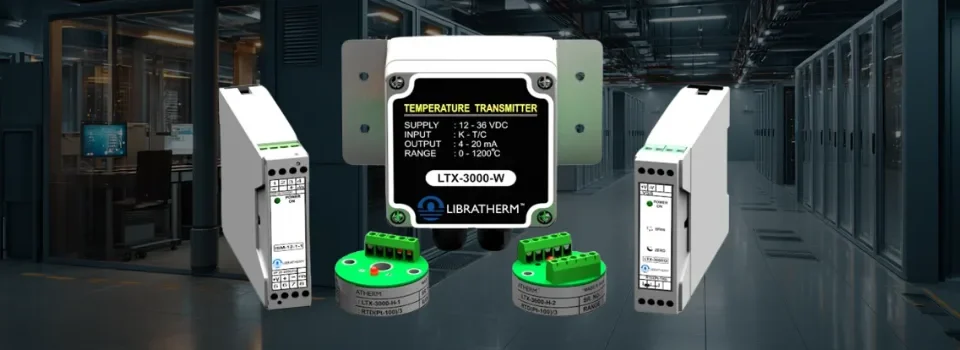
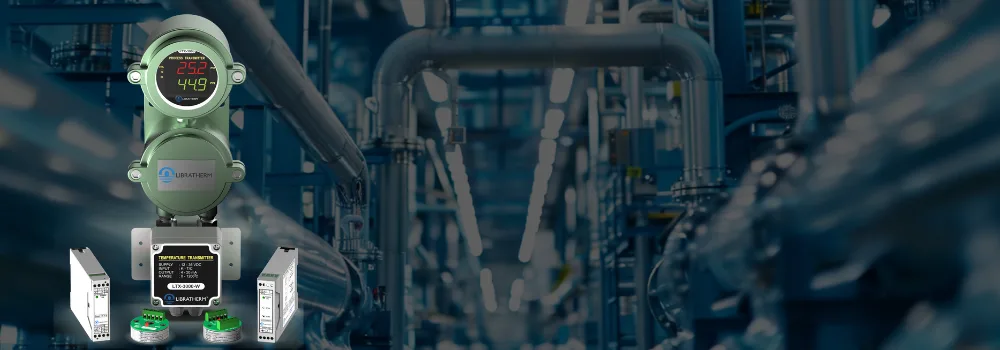
- Head-mounted transmitters are compact units installed within the sensor head and are commonly used with RTDs or thermocouples.
- DIN-rail-mounted transmitters are installed in control panels for simplified wiring and easy access.
- Field-mounted transmitters feature weatherproof, durable housings suitable for outdoor or harsh environments.
Choosing the Right Transmitter
For precise measurements, steady signal transmission, and long-term system dependability, selecting the appropriate transmitter is essential. The perfect transmitter should be compatible with the sensor type, provide the required output format, meet the isolation and accuracy requirements, and withstand the climatic conditions at the installation site. By aligning these factors with your PLC, DCS, or SCADA system requirements, you can ensure smooth integration and optimal control performance.
Key Takeaways
- Selecting the right transmitter is essential for accurate, reliable measurements and clear signal transmission, minimising noise and maintaining integrity.
- Libratherm provides transmitters for temperature, humidity, pressure, and universal signals. Each model delivers industrial precision, electrical isolation, and long-term stability.
- For new process integration or control system upgrades, optimal transmitter selection directly improves plant efficiency, operational safety, and system performance.