What is a Signal Isolator and Why It’s Essential in Industrial Automation

Introduction
Reliable industrial automation begins with accurate measurement and trustworthy control, both of which rely on high-quality signals from field instruments to PLCs, DCS, and SCADA systems. However, signal quality is often undermined by electrical noise, multiple grounding points, long cable runs, and power disturbances. Even advanced automation systems can yield incorrect results if the signals are distorted.
Signal isolators maintain accurate signals by blocking noise, protecting equipment from disturbances, and ensuring reliable operation.
What is a Signal Isolator?
A signal isolator is an electronic device that electrically separates input and output circuits to block interference and protect equipment. This isolation prevents unwanted current, voltage feedback, and interference, safeguarding sensitive equipment and ensuring stable, reliable signal transmission in automation systems.
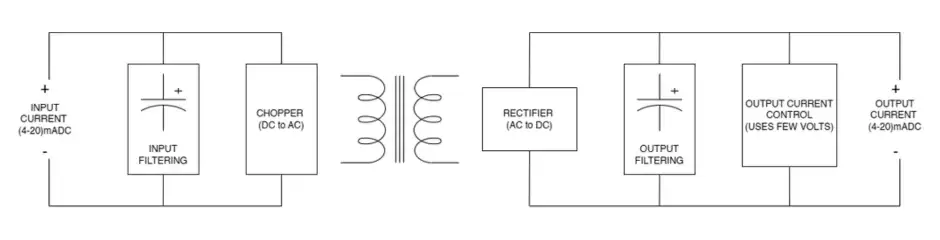
The device isolates circuits via optical, magnetic, or capacitive coupling. Optical isolation utilises optocouplers to convert electrical signals into light and back, thereby maintaining separation in low-power and control applications. Magnetic isolation utilises transformers to transfer signals through electromagnetic induction, thereby providing high-voltage protection. Capacitive coupling utilises capacitors to transfer energy through changes in electric fields, making it particularly effective for high-frequency signals. Each method passes the intended signal and blocks noise and interference.
During operation, the signal isolator receives an input (4-20 mA, 0-10 V, or ±10 V) and transmits it across the isolation barrier, producing a proportional, accurate output. This maintains the original measurement and removes noise, drift, and ground potential differences.
They support a wide range of input and output signals, ensuring compatibility across PLCs, DCSs, and process instruments. Accuracy is typically within ±0.1%, ensuring dependable conversion of measurements. Most industrial isolators use a stable 24 V DC supply, making integration into control panels and automation systems easy.
Why Signal Isolation Is Essential in Industrial Automation
Ground Loop Prevention
In many industrial plants, instruments and controllers connect to different grounding points. When these grounds differ in electrical potential, unintended ground loop currents can form. These currents distort measurement signals, causing erratic readings, unstable control, and false alarms. A signal isolator breaks the electrical path between input and output using optical, magnetic, or capacitive isolation. This passes only the signal information, eliminating the need for a shared ground reference. It completely prevents ground loop interference, ensuring accurate and stable transmission, particularly in large plants with extensive cable networks.
Noise and Interference Elimination
Industrial environments generate electrical noise from VFDs, motors, heaters, solenoids, and switching devices. This noise interferes with analogue signal lines such as 4-20 mA or 0-10 V, distorting sensor output and destabilising process measurements. Signal isolators block and filter this noise before it reaches the PLC, DCS, or controller input. The isolation barrier protects against EMI and RFI, ensuring the control system receives accurate data. This improves closed-loop control and reduces troubleshooting time.
Protection of Equipment
Modern PLCs, DCS systems, controllers, and data acquisition modules use low-voltage, high-density electronics that are vulnerable to electrical disturbances. Voltage spikes, lightning surges, wiring faults, sensor short circuits, and improper grounding can all travel through signal wiring and cause damage. A signal isolator acts as a protective barrier, preventing high voltages or fault currents from reaching sensitive control hardware. If a surge occurs on the input side, the output side remains safe. This protection prevents costly equipment failures, reduces downtime, and extends asset life.
Improved System Stability
When multiple instruments and control loops are interconnected, minor electrical disturbances or measurement inconsistencies can accumulate. This impacts process quality. Without isolation, environmental changes or electrical interference may cause analogue signals to drift. A signal isolator transmits only accurate, linear representations of measured variables. This ensures stable readings, improved repeatability, and greater measurement precision. These benefits are especially important in multi-loop process plants, SCADA systems, and distributed control networks. Greater stability directly enhances process efficiency, product quality, and operational reliability.
Types of Libratherm Signal Isolators and Conditioners
DC to DC Signal Isolator
- Input: 4–20 mA, 0–10 V, 0–5 V DC signals
- Output: Isolated 4–20 mA or 0–10 V DC
- Use: Protect PLC/SCADA analogue inputs, eliminate ground loops, and scale DC process signals.
AC to DC Signal Converter
- Input: AC voltage or current (e.g., 0–230 V AC, 0–5 A AC)
- Output: Corresponding isolated DC signal (e.g., 4–20 mA, 0–10 V)
- Use: Monitoring motor load, power, or line voltage in automation panels.
Frequency to DC Converter
- Input: Frequency signal from flow, speed, or pulse-generating sensors.
- Output: Linear DC signal proportional to frequency.
- Use: For measuring speed, flow rate, or pulse count in process equipment.
Temperature to DC Converter
- Input: Temperature sensor (RTD or Thermocouple).
- Output: Isolated 4–20 mA or 0–10 V signal proportional to temperature.
- Use: Acts as a transmitter with built-in isolation and scaling.
Load Cell Signal Conditioner
- Input: Low-level mV signal from strain gauge/load cell.
- Output: Isolated 4–20 mA or 0–10 V DC signal.
- Use: Converts weak load cell signals into robust industrial process signals.
Choosing the Right Signal Isolator
Selecting the right signal isolator involves identifying the input signal type (DC, AC, mV, frequency, or sensor output), choosing the appropriate output format for your PLC or DCS, and ensuring sufficient galvanic isolation to protect against noise and ground loops. It is also important to verify power-supply compatibility, select a suitable mounting style (DIN rail or field enclosure), and confirm the required accuracy and linearity to ensure stable signal transmission. Finally, consider the operating environment, including temperature, vibration, and enclosure protection, to ensure reliable performance in industrial conditions.
Key Takeaways
- Signal isolators are vital for preventing ground loops, electrical noise, and interference in process measurement and control systems.
- Choosing the right isolator ensures accurate signal transmission. It also improves system safety and long-term operational reliability.
- Libratherm offers a comprehensive range of isolators for DC, AC, frequency, temperature, and load cell signals. These are engineered for industrial environments and OEM integration.
- Consider input type, output format, isolation rating, accuracy, and environmental conditions. This ensures you select the most suitable isolator for your application.