Understanding Temperature Transmitters | The Backbone of Accurate Process Measurement
Introduction
Temperature is among the most monitored and tightly regulated parameters in industrial processes. Whether heating, cooling, reacting, melting, or preserving materials, temperature shapes product quality, safety, energy use, and process reliability. Even slight fluctuations can lead to defects, equipment failure, or inefficiency.
Accurate measurement is vital for stable temperature control. Sensors such as thermocouples and RTDs sense temperature fluctuations. Their raw outputs are weak voltages that often behave non-linearly and are susceptible to industrial electrical noise. Temperature transmitters are crucial; they convert these flawed sensor signals into stable, standardised outputs that PLCs, DCS, SCADA, or controllers can accurately read. This makes them the indispensable link between field measurement and process control.
What is a Temperature Transmitter?
A temperature transmitter is an electronic device that accepts raw input from a sensor and converts it to an electrical signal. This output can be an analogue signal, such as 4-20mA or 0-10V, or a digital communication protocol like RS-485/MODBUS.
This conversion is required as the raw signal received from the sensors can not be applied directly to appliances due to certain factors, such as:
- They are highly susceptible to noise and electrical disturbances.
- Over long cable distances, voltage drops can result in signal loss or drift.
- Calibration may vary between sensors, leading to inconsistent readings.
Using a temperature transmitter solves these challenges by conditioning, linearising, and amplifying the signal. This ensures reliable and accurate measurement, significantly improving control performance and system stability.
Working Principle
The temperature transmitter receives input from the temperature sensor, draws current from a DC power supply, and transmits the signal by varying this current. For instance, a thermocouple input transmitter draws a current of 4 mA from the power supply when measuring the lowest temperature. Then, as the temperature increases, the transmitter draws a proportionally greater current until it reaches 20 mA, the maximum temperature the sensor can sense.
In other words, 4 mA and 20 mA correspond to the sensor's lowest and highest temperatures, respectively. For example, if the sensor's temperature range is 0-100 ℃, a 4 mA signal would correspond to 0 ℃. In the same way, 20mA would mean 100℃. When using RTD, the Wheatstone bridge is used to create a low voltage at its end. This signal is amplified to generate a 4-20mA signal.
Temperature transmitters interface directly between the control system and the temperature sensor. They isolate, amplify, linearise, and convert the sensor’s input signal, then send a standardised output to the control system. This process ensures accurate temperature monitoring and minimises interference.

Types of Temperature Transmitters
Head-Mounted Temperature Transmitters
Mounting Type
These transmitters are installed directly inside the sensor head – typically a DIN Form B enclosure that sits on top of the thermocouple or RTD assembly. As a result, they are positioned close to the sensing element, supporting responsive measurement.
How They Work
By converting the low-level sensor signal (mV or Ω) into a stable 4–20 mA output at the measurement point, these transmitters effectively minimise signal loss and electrical interference. This conversion capability is key to their reliable performance in industrial settings.
Use Case / Ideal Applications
- Field-mounted temperature measurement points in process plants.
- Outdoor or harsh environments that require noise immunity.
- Suitable for pipes, tanks, furnace zones, boiler temperature points, oil & gas wellheads, etc.
Advantages
- Reduces noise pickup caused by short sensor wiring.
- Compact and protected from dust, moisture, and temperature fluctuations.
- Easy to integrate with PLC/SCADA systems.
DIN Rail Mounted Temperature Transmitters
Mounting Type:
These transmitters are mounted on DIN rails, which are standardised metal rails used to mount electrical devices in control panels, junction boxes, or MCC/instrumentation cabinets.
How They Work:
Sensor leads run from the field to the control panel, where these transmitters condition and convert the signal to a stable analogue output.
Use Case / Ideal Applications:
- Centralised instrumentation rooms and control panel-based installations.
- Situations requiring organised wiring, easy maintenance, and fast replacement.
- Factories are adopting modular instrumentation panel architecture.
Advantages:
- Neat panel installation reduces wiring complexity.
- Convenient access for calibration and troubleshooting.
- Best suited for situations where multiple transmitters must be grouped at a single location.
Loop-Powered (Two-Wire) Transmitters
Mounting Type:
Can be either head-mounted or DIN rail-mounted, but electrically they operate on a two-wire 4–20 mA loop, where the same pair of wires provides both signal transmission and power supply.
How They Work:
These transmitters regulate the loop current in proportion to the sensed temperature, eliminating the need for an additional power supply unit.
Use Case / Ideal Applications:
- Distributed field installations with long cable runs.
- Energy-efficient and cost-sensitive applications.
- Ideal for industries standardising on 4–20 mA signal loops for noise immunity.
Advantages:
- Reduced wiring requirements help lower overall installation costs.
- These transmitters offer low energy consumption while maintaining high operational reliability.
- They simplify system design, especially in large process plants with multiple measurement points.
Sensor Input Types Supported
RTD (Pt-100 / Pt-1000)
RTDs (Resistance Temperature Detectors) such as Pt-100 and Pt-1000 are commonly used in industrial applications that require high accuracy and long-term stability. These sensors operate on the temperature-dependent change in the electrical resistance of platinum. They are best suited for low- to moderate-temperature ranges, offering excellent repeatability and reliability. RTDs are typically used in applications like HVAC systems, water process control, cleanrooms, pharmaceutical manufacturing, and laboratory environments, where precise temperature measurement is essential.
Key Benefits:
- High measurement accuracy and stability
- Minimal signal drift over long durations
- Ideal for precise temperature monitoring between –200°C to +600°C
Thermocouples (J, K, R, S, T, etc)
Thermocouples operate based on the voltage generated between two dissimilar metals and are known for their ability to withstand very high temperatures and harsh industrial conditions. They are suitable for applications involving furnaces, heat treatment plants, foundries, boilers, and metal processing, where temperature levels can exceed 1000°C. Thermocouples are rugged, reliable, and respond quickly to temperature changes, making them ideal for dynamic and high-heat applications.
Key Benefits:
- Capable of measuring extremely high temperatures
- Robust and resistant to vibration and mechanical stress
- Available in a wide range of types to match process conditions
Output Signals & Communication
Analogue Outputs
- 4-20 mA (industry standard): Immune to noise, ideal for long cable runs.
- 0-10 V: Suitable for panel wiring and short distances.
Digital Communication
- RS-485 / Modbus
- SCADA / PLC / DCS integration possibilities.
Applications Across Industries
- Process plants include those in the chemical, petrochemical, and pharmaceutical industries.
- Food and beverage processing.
- Furnaces, kilns, boilers, and heat treatment.
- HVAC and energy management.
- Steel and non-ferrous metals.
- Water treatment and environmental monitoring.
Benefits of Using Temperature Transmitters
- These transmitters enhance measurement accuracy and stability by conditioning, linearising, and compensating raw sensor signals.
- They significantly reduce noise, interference, and ground-loop issues, thereby improving system reliability.
- Wiring, installation, and maintenance become simpler, particularly in complex industrial infrastructures.
- Consequently, improved measurement accuracy leads to better process control and operational efficiency.
- Lower lifecycle and calibration costs are achieved because robust performance reduces maintenance frequency and the need for recalibration, resulting in tangible long-term savings.
How Libratherm Supports Your Temperature Measurement Needs
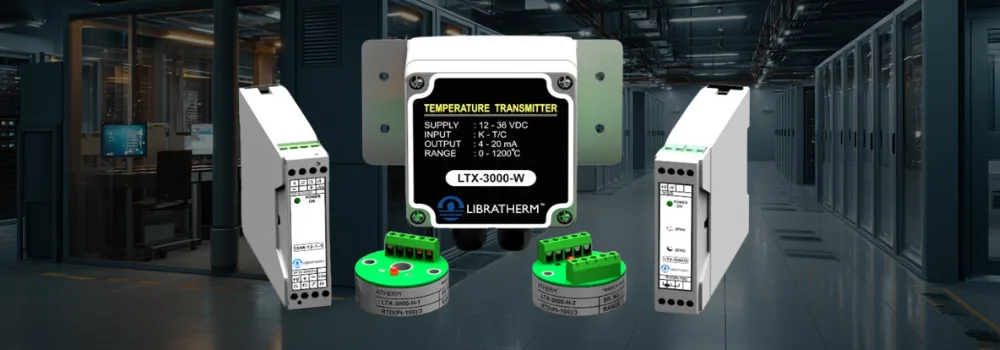
Libratherm provides a comprehensive range of loop-powered and DIN rail-mounted temperature transmitters for industrial environments. We engineer our transmitters for high accuracy, galvanic isolation, and long-term reliability in the field. Each model supports both RTD and thermocouple inputs, with options for 4–20 mA, 0–10 V, and RS-485 Modbus communication protocols.
We also offer:
- Customisation support for OEMs and machine builders.
- Application-specific calibration services for precise measurement.
- Technical assistance and after-sales support to ensure reliable long-term operation.
Conclusion
Temperature transmitters provide accurate, stable, and reliable measurements in industrial processes. They convert weak sensor signals into standardised outputs. This enables precise monitoring and control in furnaces, reactors, water treatment, and HVAC systems. They maintain signal integrity, simplify wiring, and integrate with PLCs or SCADA systems. This makes them essential for automated operations. Select the appropriate transmitter type to enhance plant efficiency and measurement accuracy.
Key Takeaways
- Temperature transmitters deliver accurate measurements without interference in industrial environments.
- They make system design easier, reduce wiring costs, and help improve process safety.
- Different types of transmitters are available to meet specific installation and environmental needs.
- Choosing high-quality transmitters helps ensure reliable performance and steady control over time.
- Libratherm offers a wide range of transmitters designed for accuracy, durability, and easy integration with PLC-based systems.